
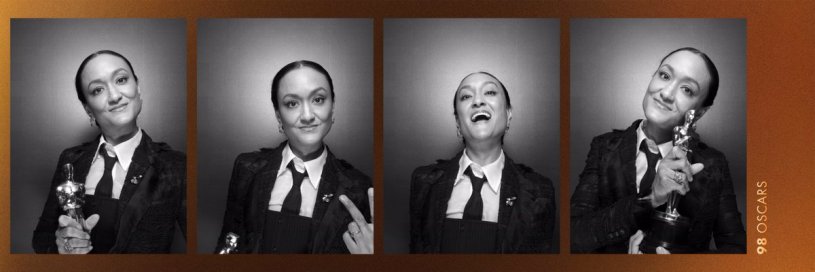
Story by: Madison Smith & Walker Payne
MONTEVALLO, Ala. — The 2026 awards season may have come to an end, but one of the Academy Awards’ most significant moments continues to spark conversation.
In a historic first, Autumn Durald Arkapaw became the first woman to win the Best Cinematography Oscar for her work on the record-breaking film “Sinners,” overcoming a long-standing barrier in one of Hollywood’s most male-dominated fields.
Many women within the film industry are reacting to the historic achievement, with Montevallo’s own Dr. Kaley Martin being no exception.
“It was a huge day for women in film,” Martin said. “Women have been nominated in this category, at least two or three times… with the earliest being 2018. And this was the first time in the Academy’s 98-year history that a woman had not only been nominated but took home the Oscar.”
Dr. Martin, who has spent a decade working in videography and filmmaking, said that women are too often forgotten or disregarded by the Academy and Hollywood in general.
However, Arkapaw’s win not only recognizes exceptional craftsmanship, it also signals a shift toward greater representation behind the scenes.
With the nomination and award, Arkapaw not only became the fourth woman ever nominated in the category, but she also became the first woman of color to ever receive the nomination and eventual win.
However, the general lack of nominations for women and creatives of color stretches much further than the cinematography category.
History of Women Nominees at the Oscars
Both women creatives and creatives of color have long been underrepresented in the Academy.
As of 2023, around 33% of the Academy’s members were made up of women, and only 19% were made up of people of color.
In 2026, the statistics remain nearly the same.
“Film is a male-dominated industry, but it’s funny, film actually started as a female-dominated industry…” Martin said. “Unfortunately, when women’s rights and things like that started to come up through our history, women’s involvement in film actually decreased because film became more commercialized and corporatized.”
Specifically, only nine women in the entire history of the Oscars have ever been nominated for Best Director.
The first woman nominated for Best Director was Lina Wertmüller for “Seven Beauties” in 1975, and it took 47 years to finally reach that achievement.
Years later, Wertmüller was followed by:
- Jane Campion for “The Piano” (1993)
- Sofia Coppola for “Lost In Translation” (2003)
- Kathryn Bigelow for “The Hurt Locker” (2009)
- Greta Gerwig for “Lady Bird” (2017)
- Emerald Fennell for “Promising Young Woman” (2021)
- Chloé Zhao for “Nomadland” (2021)
- Jane Campion for “The Power of the Dog” (2022)
- Justine Triet for “Anatomy of a Fall” (2024)
- Coralie Fargeut for “The Substance” (2025)
- Chloé Zhao for “Hamnet” (2026)
With that, Bigelow, Zhao, and Campion are the only three women who won the award for Best Director, and Zhao still remains the only woman of color to be nominated in the category.
As for Best Actress, only 33 women of color have been nominated, with zero women of color receiving a nomination this year.
Further, out of the 33 women ever nominated, only two, Halle Berry and Michelle Yeoh, went on to win the award.
Thus, for many, this moment is about far more than just one award; it represents progress and possibility for all future filmmakers.
“For women to not only see that you can make it to a nomination period, but also you can win, it just again shows that that glass ceiling that’s been there for women in film is starting to break,” Martin said. “It’s starting to come down.”
 Vallo Vision News