
By: Jayden Presley, Vallo Vision News
MONTEVALLO, ALA. – Expertise and simplified graphics can be helpful for people to understand COVID-19 data. Breaking down the data with graphics can be a good way to visualize and absorb the information.
Understanding COVID-19 data and how it relates locally may not be easy for many people. Websites offer charts and numbers, but the data is not always simplified.
University of Montevallo COVID-19 Statistics

by Jayden Presley
Local statistics for the University of Montevallo are a good starting point. UM updated the COVID-19 Case Reporting webpage for the week of Oct. 17, 2021.
UM students are not required to report vaccination status; therefore, the data of vaccinated students are only estimates. Survey estimates of vaccinated individuals on campus can be found in this article here.
As of Oct. 19, 124 students at UM are cleared from isolation out of 126 reported COVID cases.
An overall number of more than 1,300 people tested for COVID, and almost 40 tests were positive. Nearly 100 tests given for the week of Oct. 17 had negative results.
Shelby County COVID-19 Statistics

by Jayden Presley
Thirty-two percent of residents in Shelby County, Alabama are fully vaccinated, based on the CDC’s County View website.
Shelby County’s population is about 223,024 as of 2020, based on the Data Commons database.
As of Oct. 22, over 221,000 vaccine doses are administered to residents, according to the ADPH COVID-19 Dashboard Hub.
On average, USA Facts data reports almost 50 new cases are reported each day along with one death related to COVID. Shelby County COVID cases totaled over 37,000 and nearly 350 deaths.
Alabama COVID-19 Statistics
by Jayden Presley
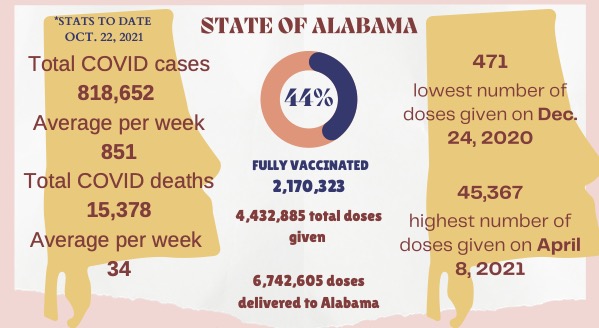
Alabama’s population is about 5,024,279 as of 2020. The number of vaccinated individuals is close to 44 percent.
COVID vaccines delivered are 6.8 million in Alabama and over 4.4 million vaccine doses have been given to Alabama residents, according to ADPH.
As of Oct. 22, statewide COVID cases totaled over 800,000 and over 15,000 deaths. USA Facts website for Alabama statistics can be found here.
On average, 34 deaths occur per week and over 850 new cases are reported.
U.S. COVID-19 Statistics

by Jayden Presley
The U.S. population as of 2020 is about 331,449,281. Information about population can be found here.
CDC statistics report 57.4 percent of the U.S. population is fully vaccinated.
As of Oct. 23, vaccine doses given to U.S. citizens totaled over 410 million out of over 500 million delivered.
COVID cases totaled over 45 million and over 730,000 deaths. In the last seven days, over 490,000 new cases are reported and almost 9,000 deaths related to COVID have occurred in the U.S.
Expertise by Dr. Hardig
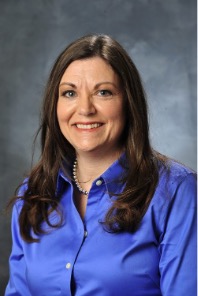
Dr. Sally Bennett Hardig is a professor and program coordinator of communication studies at UM.
She teaches classes that focus on persuasion and rhetorical messaging in a variety of contexts, including health communication.
Courtesy of
UM Marketing
and Communications
Many people are unsure whether to take the COVID-19 vaccine. Hardig said people are hesitant for many reasons.
“A variety of methods have to be employed to reach multiple diverse audiences,” said Hardig. “Probably most important is to take the politics out of any message. People lack trust and need to see people like themselves complying.”
Communication methods used by media companies are influential in giving vaccine information or vaccine encouragement, but Hardig said some methods result in convincing people to not take the vaccine.
“Name calling is never effective in persuading already hesitant people,” said Hardig. “Framing the vaccine politically also often creates boomerangs—meaning people use the issue as a wedge to highlight division and mistrust in the institutions.”
Perhaps by leading with compassion and kindness, we could avoid some of the negativity.
Dr. Sally Bennett Hardig
Hardig said there is no simple answer in convincing vaccinated people to not be wary of those unvaccinated.
“One of the problems with communication about this issue is how we tend to make sweeping generalizations and assumptions about why people choose to vaccinate or not,” said Hardig. “We also get distorted information about who is at risk.”
She mentioned how people may be immunocompromised, or they have an elderly relative.
“In that case, they have reason to fear unvaccinated. The way they express this fear to the people around them is key,” said Hardig. “This could be an opportunity to learn if the individuals involved are willing to listen to each other and try to understand what is behind the fears. Perhaps by leading with compassion and kindness, we could avoid some of the negativity.”
 Vallo Vision News