
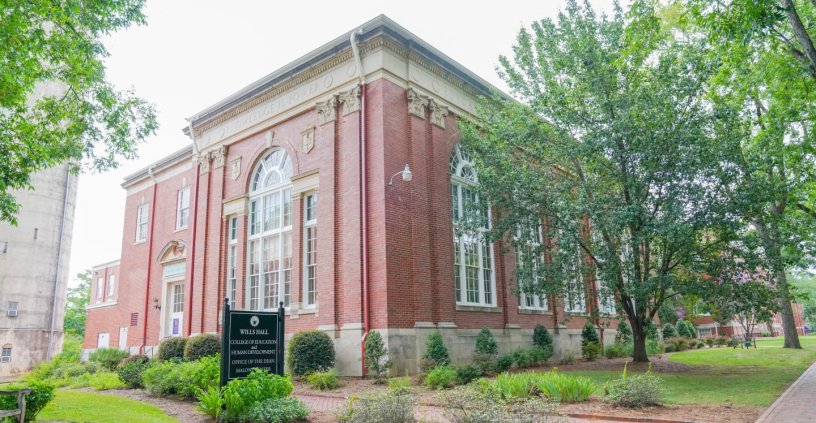
Update: The UM board of trustees unanimously approved a recommendation to close the undergraduate Education of Deaf and Hard of Hearing major during its May 5 meeting. The recommendation now goes to the Alabama Commission on Higher Education, which will meet on June 13.
The original article is below:
MONTEVALLO, Ala. – The University of Montevallo’s Undergraduate Curriculum and Standard’s Committee has approved a recommendation to withdraw the undergraduate Education of Deaf and Hard of Hearing major – which is currently the only one in the state of Alabama, according to Dr. Courtney Bentley, provost and senior vice president for academic affairs.
The proposal was voted on at the April 18 UCSC meeting, and it has since been approved by the executive cabinet. The recommendation will be presented to the board of trustees at its May 5 meeting. If approved by the board, the recommendation then goes to the Alabama Commission on Higher Education, which will meet June 13. Dr. Bentley said ACHE would vote on the recommendation that day.
If approved by ACHE, UM would immediately stop accepting new majors into the EDHH program.
However, students interested in the Deaf Studies minor would still be able to declare that minor going forward. Dr. Bentley also said UM’s online alternative master’s degree in EDHH will remain.
Dr. Frances Courson, an assistant professor of EDHH, said she is relieved that the minor and graduate program are continuing.
“The two work well together,” she wrote in an email to VVN. “Students who complete the Deaf Studies minor will have already met many of the prerequisites for the master’s program, creating a strong and accessible pathway.”
Impact on currently declared EDHH majors
Currently declared undergraduate majors – and incoming students who declare the major prior to June 13 – would be able to finish their EDHH degree through what is known as a “teach-out plan.”
Under a teach-out plan, faculty will map out a major’s entire course of study to be completed in four years, Dr. Bentley explained. The plan would include both general education and major courses.
“Deaf and Hard of Hearing is like all our education programs. There’s not a lot of wiggle room anyway,” she said. “It’s very lock-step. So they’ll go through and put together that [plan] for each student. They’ll be individualized per student.”
Currently, there are 15 undergraduate EDHH majors, nine Deaf Studies minors and eight students in the graduate program, according to Dr. Courson. There are another 15 undergraduate students admitted to the program for the fall, she said.

Deciding factors
Dr. Bentley attributed the decision to end the EDHH major to two main factors: financial viability and better ensuring UM instruction prepares students fully for real-world employment.
“A contribution margin analysis shows that the undergraduate deaf and hard of hearing program is not financially viable,” Dr. Bentley explained. “It’s also pedagogically not the best approach because, in the state of Alabama, it is a Hearing Impaired endorsement within a special education certificate.”
The current pedagogical structure means that sometimes EDHH graduates take special education jobs that they may not be fully prepared for, according to Dr. Bentley.
“We’re trying to do what’s in the best interest of our students, and then also provide the services to the state that we’ve provided,” Dr. Bentley said, “but in a way that is sustainable and financially viable for us.”
There is still a path forward for UM students interested in deaf education and obtaining the Hearing Impaired endorsement.
We’re trying to do what’s in the best interest of our students, and then also provide the services to the state that we’ve provided, but in a way that is sustainable and financially viable for us.
Dr. Courtney Bentley, Provost & Senior Vice President for Academic Affairs
“They can major in special education and take the deaf studies minor – which we’re keeping the minor – and then when they complete [their undergraduate degree], they’ll have a special education certificate, which allows them to go into deaf and hard of hearing placements,” Dr. Bentley said. “And they have three years to complete the Hearing Impaired component of that certification that they can do in the alt master’s program.”
According to Dr. Courson, only about half of education majors nationwide pursue a master’s degree, and she said she is concerned about the broader impact of UM’s undergraduate EDHH major going away.
“Requiring students to earn a master’s degree in order to become certified in Deaf education in Alabama may reduce the number of new teachers entering a field that is already experiencing significant shortages,” she wrote. “Based on the most recent data available, the United States is currently short approximately 500 Deaf Education teachers. Maintaining and expanding pathways into this profession is essential to meeting the ongoing needs of students who are Deaf and hard of hearing.”
Programs like Deaf Education are not designed to produce large enrollment numbers. They are specialized, high-need fields where even a small number of graduates make a profound impact over their careers.
Dr. Frances Courson, Assistant Professor of EDHH
Since 2019, the EDHH program has graduated 38 combined undergraduate and graduate students, according to Dr. Courson.
“Programs like Deaf Education are not designed to produce large enrollment numbers,” she wrote. “They are specialized, high-need fields where even a small number of graduates make a profound impact over their careers.”
UM’s online EDHH alternative master’s program
The online alternative master’s program is for people who have a bachelor’s degree outside of education with a desire to teach deaf or hard of hearing students ranging from preschool to 12th grade, according to the University of Montevallo website.
Students who complete the graduate program will earn both a master’s degree and a Class A teaching certification.
Admission requirements for alternative master’s program include:
- A bachelor’s or graduate degree from a regionally accredited college or university
- Praxis II Elementary Education: Three Subject Bundle
- Teaching Education Program interview
- Fingerprint and background clearance
More details about admission requirements and an overview of coursework can be found here.
Dr. Courson said similar programs have been closed at universities across the country. Utah State University announced the planned closure of its ASL / Deaf Education Teacher Prep Program earlier this month. She said the impact of closures like the one at USU on interest in UM’s online master’s program is still unknown.
“We have not yet fully seen how closures at other universities will affect our program,” she wrote, “but the situation has definitely gained national attention on social media. … We have seen increased interest from students who had been undecided but are now moving forward with applications.”
Adding ASL option for B.A. degrees
Although the EDHH major is slated to end, UM students will have the opportunity to take American Sign Language courses and have them count toward the world language requirement for bachelor of arts degrees starting in the fall of 2026.
UM currently requires students pursuing a B.A. to complete two full years of a world language – a requirement Dr. Bentley said made UM “more rigid than most” other universities.
However, at its April meeting, UCSC approved a change to the world language requirement of bachelor or arts degrees that would give students the choice completing the current world language requirement or take two different languages for a year each.
For instance, under this change, a student could take one full year of Spanish and one full year of ASL to satisfy the B.A. requirement.
Dr. Courson strongly encourages students to consider taking ASL classes to satisfy the B.A. requirements.
“ASL is a valuable, versatile skill used across education, healthcare, business, and more venues,” she wrote. “It connects learners to the Deaf community, enhances visual and cognitive skills, and broadens future career options.”
A separate proposal to include ASL courses under Area 2 of general education is being discussed, according to Dr. Bentley. This would allow students to take ASL courses as part of the humanities and fine arts requirements in the general education curriculum.
This change would also need to be approved by UCSC. Dr. Bentley said this plan will go before that committee later this year. “It will appear on UCSC’s agenda in the fall, but it would not be consequential until the fall of ’26.”
The future of Deaf Education at UM
Dr. Bentley said the changes in the B.A. requirement could end up helping the EDHH major return at some point in the future by allowing faculty to recruit more students.
“Just because we close a program now doesn’t mean it’s closed in perpetuity,” she said, “You know, if the changes in the B.A. do what I think they do – which means some students would take some language who otherwise would take none – it could be an opportunity for them to recruit [and] grow their minor. And then we could revisit viability down the road.”
But Dr. Courson fears that opportunity may come too late.
“Once programs like this are lost, they are rarely reestablished,” she wrote. “Protecting pathways into Deaf education now is critical, because rebuilding them later is often too late for the students who need them today.”

