
by: Becca Langford
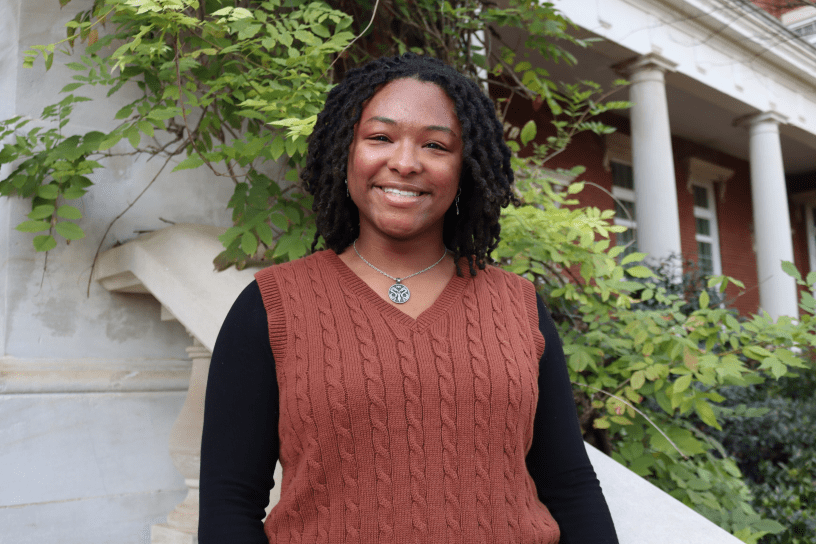
Jada Tubbs has been writing stories in her head since she was a kid.
Always coming up with short dialogues between characters, Tubbs said she has always wanted to be able to show people those stories, and figured the best way to do that was through film.
By the time she reached high school, she was opting for TV and film electives, starting with a video production class where she says her interest in the art really bloomed.
Later on, during her senior year of high school, she found out about the Sidewalk Film Festival, an annual film festival in Birmingham, AL, through a teacher whose former student was over the youth board at the time. Tubbs reached out to them and got accepted to be on the board where she got the opportunity to work on and direct a short film, and thus started her career as a filmmaker.
“This got me really excited to work with others on big projects to make a dream come to life,” said Tubbs, “So when I got to Montevallo, my mind was made up. I was majoring in mass communication so I could keep creating and learn the whole process of what it takes to make an idea materialize into a visual story.”
Being a graduating senior, Tubbs is required to complete a capstone project showing the skills she’s learned in undergrad, and figured it was the perfect opportunity to create a short film while she still has access to the equipment available at the university.
Tubbs’ film, “The Date”, is a queer short film about a girl who is trying to figure out the unclear motive behind a night out with her crush. It was inspired by the lack of family friend queer films – in particular ones centered around queer women, who are often incredibly sexualized.
“As a bisexual woman, I wanted to create a story where women have room to be attracted to each other without that attraction being inherently sexual,” said Tubbs.
Tubbs said the writing process took a lot longer than originally expected because writing dialogue was surprisingly difficult. “Writing dialogue requires a natural flow. While trying to keep up with the flow, you also have to keep in mind the personality of the characters you’re writing. So in a way, you’re not even writing for yourself, but you’re putting yourself into the mind of this person that doesn’t even exist to figure out their mannerisms and language.”
While it was time consuming, she said it was really fun to create characters from scratch.
The filming process was equally as fun to Tubbs, but very stressful. With this being her first solo project, she said she learned a lot through trial and error. Going into it, she wanted everything to be perfect, but had to remind herself that she is still learning and you have to make mistakes to learn and improve. She looks at the minor setbacks as beneficial lessons and areas to refine for her next project.

Tubbs said overall the most difficult part of the process was finding scheduling that worked for both cast and crew, and the most difficult shoot was when she had to film in below freezing temperatures because it was the only time everyone was available for two exterior night scenes.
“It’s really hard to focus on directing a group of freezing people while you’re freezing yourself and everyone’s looking to you for what to do next,” said Tubbs. Fortunately, it turned out to be a productive shoot and a beneficial experience she is grateful to have had.
Tubbs said the most rewarding part of the whole experience has been the editing process, which she is currently in, and being able to see the story she created come to fruition. The rough cut is almost completed and then she will be making final tweaks like adding credits.
Once done, Tubbs will be submitting it to film festivals, so it won’t be available to the public until after she hears back from those. However, after that, it will be up on her YouTube channel, directedbyjada.
When asked what advice she would give to someone writing and directing their own short film, Tubbs says don’t be afraid to make mistakes, it’s part of the process and that it’s better to start creating and work with the knowledge and tools that you have available to you now rather than giving up on an idea completely and having nothing to show for it.
“Don’t be afraid to create things that haven’t been done before. It’s fine to take inspiration from other people’s work, but don’t allow your work to be a recreation of someone else’s because you think it’s what people want to see. Write about what you care about because if you don’t care about it, it’ll be very noticeable. If you like what you’re creating and are passionate about it, it’ll show in the work, and there will be someone else out there who will appreciate your passion and authenticity.”
 Vallo Vision News