
Story by: Andriana Rangel
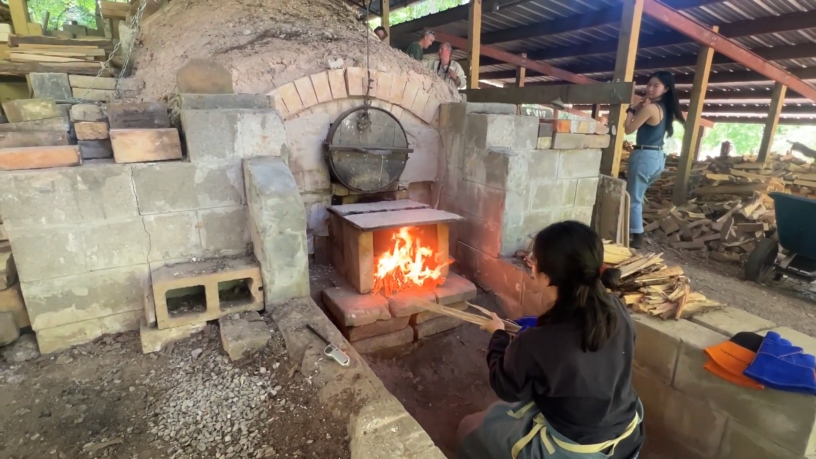
On Tuesday, April 18, the College of Fine Arts lit its 40-foot-long anagama kiln. The kiln sits in the wood near the student retreat center.
This marked the beginning of multi-day, multi-site event known as World-Fire, which continues through April 22.
In addition to UM’s kiln, four other kilns across the globe were also lit. And all of the artists involved can watch and communicate with each other live.
Connecting kilns across the globe
After Zoom revolutionized how people communicated with each other during the pandemic, an opportunity was presented for ceramic artists to share techniques and approaches in real time.
Using the broadcasting technology housed in Strong Hall, kilns at UM, Clemson University, and multiple sites in China can all communicate and watch each other via Skype.
Language barriers and different time zones presented challenges for the video production crew, according to Dr. Jay Cofield, Professor of Mass Communication. The team utilized interpreters and translator apps to make sure all of the artists were on the same page while making plans for World-Fire.
“A classroom on fire”
An anagama-style kiln is an ancient kiln used for baking ceramics. Around 60 pieces sit in UM’s anagama kiln.
The kiln firing was under the direction of UM Art Professor Dr. Scott Meyer.
In 2000, Meyer received a donation of materials to build a series of kilns on campus, including the 40-foot anagama kiln.
“It’s a classroom that’s on fire,” he said. “You gotta find out how flame behaves, how to control it, what it does to work. Ya know, all of it. It’s a hands-on thing.”
Volunteers will work in shifts to supervise the kiln for 24 hours a day for the next five days.
You can see more of this year’s World-Fire event on the “MontevalloForYou” channel on Youtube.
Additional reporting by Dr. Bruce Finklea
 Vallo Vision News