

Story by: Kylie Jordan
To soccer player Simon Wittmann, the sport is not just a hobby, it’s a passion. Originally from Ingolstadt, Germany, Wittmann started his freshman year at the University of Montevallo in Montevallo, Alabama, playing center defensive midfielder on UM’s men’s soccer team.
Wittmann has since transferred to two other schools to continue his soccer career. His first transfer was to St. Francis Brooklyn in New York City, New York, where they shut down their athletics program after just one semester of him being there. He now attends Coastal Carolina in Conway, South Carolina, where he plays with their Division 1 men’s soccer team.
Early Life in Germany
Wittmann started his soccer career at a young age in his home country of Germany. “I just had so much fun kicking a ball with my feet,” said Wittmann.
From the first grade, Wittmann had this passion. His parents did not let him play club soccer until the next year. “So it was the start of second grade, I believe seven years old when I would join my first soccer club,” said Wittmann.
Wittmann said that soccer in Europe is the cultural equivalent of football or baseball in the United States. The environment of club soccer in Europe is personal. Parents of players would help coach the children of their village.
“It’s a very nice environment and honestly like just kids having fun, a safe environment. Everyone knows each other and respects each other. Kids can just play, you know,” Wittmann said.
It’s a very nice environment and honestly like just kids having fun, a safe environment. Everyone knows each other and respects each other. Kids can just play, you know?
Simon Wittmann
Wittmann heard about the opportunity to continue higher education and soccer career in the United States after his last year in U19, a soccer league for players under the age of 19. The following year he would move into the adult league. The level of soccer was good for Wittmann, he said, but he wanted something more.
“I was living in Munich after my high school graduation, and I played at a club that was good level but was no professional academy,” said Wittmann. “So that’s when I thought it would be so good to play at a more professional environment again since money isn’t that tight for the same level here.”
If Wittmann had continued to play at the same level of soccer in Germany in the adult league, the practice and playing schedule would have to accommodate players whose responsibilities of work and personal lives would come before soccer. “We would train like three times a week, have one game every week, train in the evening… like just a normal adult club,” he said.
Collegiate soccer sounded more appealing for Wittmann’s current wants. In the United States, he would train almost every day to grow his level and skills as a soccer player.
To Wittmann, the idea of experiencing a new country and American college life sounded more appealing. “For us, it’s like college is very nice, but we expect something interesting and exciting from an American college. We very much expect it to be almost like similar to those movies.”
Culture Shock
Coming to the United States came with cultural changes for Wittmann, noticeable in daily life, as well as on the soccer field. First, there is a noticeable language barrier. “It was hard at the beginning, but I got used to it.”
Food was another big cultural difference for Wittmann that took him by surprise.
“I would say that it is a lot more unhealthy here,” said Wittmann about UM, “and I was kind of surprised that we as college athletes and stuff, that would give us a chance of a healthy opportunity if we could go to the caf, but it wasn’t really the case.”
Nevertheless, he still enjoys American food. “I also do like a good burger with fries, so I’m not complaining too much.”
One thing in particular that surprised Wittman was the distribution of wealth in the United States. “Back home I was used to not many people having to live under poor conditions, but I wouldn’t see that many crazy insanely rich people,” he said.
“I’ve never seen a trailer park or mobile home before in my life, so when I came to Alabama and I saw many of these very easy homes, I would say I was shocked. I don’t want to sound snobby or anything, I believe that that is a big cultural difference.”
Soccer styles were something Wittmann had to adjust to, as well. In Europe, many soccer teams focus more on playing from the back of the field, which includes utilizing goal kicks, short passes, and passes on the ground to move forward. In the United States, Wittmann experiences playing with longer and higher passes.
Wittmann also believes that American soccer is more physical, with less emphasis on tactically. “Nevertheless, I mean for me it was beneficial because I’m a tall, strong guy who has a good technique but not phenomenal technique on the ball, so for me it was kinda better for me this way,” he said.
Nevertheless, I mean for me it was beneficial because I’m a tall, strong guy who has a good technique but not phenomenal technique on the ball, so for me it was kinda better for me this way.
Simon Wittmann
Being in Alabama is something Wittmann is grateful for as his first experience in the United States. The University of Montevallo is in a small town, which gave him a better opportunity to adjust. “I would say that I can always be glad, again, to have a more extreme example, where I’m coming from small-town Alabama to big, big city New York City,” he said.
One thing that keeps Wittmann connected to his life back home in Germany is his family. He says he has weekly calls that allow him to stay updated with his parents and siblings. “We just get together and talked for like two hours straight. There is definitely the strongest bond.”
Wittmann said it is still difficult to feel connected with a seven-hour time difference, but going home for breaks is the best way to reconnect.
Transfer Experience
Wittmann has experienced many upsets with transferring twice to two different schools in two different states after his time at UM. His biggest upset wasn’t his first school canceling their athletics program, allowing him another transfer, but his experience having to adapt to different soccer programs.
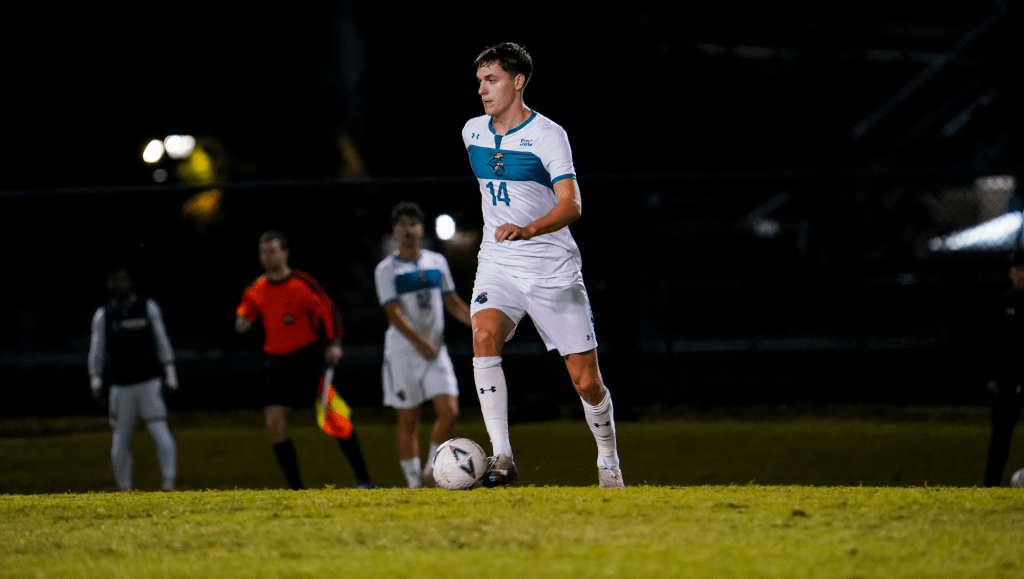
“Even though the school is nice and it’s a really nice place, it’s a D1. We play against the best teams in the country,” he said, “but it’s such a toxic environment, which made it so hard to just be there and enjoy anything to be honest.”
Wittmann also said he was frustrated by his lack of playing time this season, as opposed to the University of Montevallo, where he started all 16 games his freshman and sophomore year.
What’s Next for Wittmann?
Post-graduation, Wittmann is still unsure of his potential. “I’m planning, first of all, to graduate in Fall 2024. I hope I can make that work,” he said.
After he graduates, Wittmann has the option to think about optional practical training (OPT), which allows him to stay in the United States for another year to practice in his area of study, exercise and nutrition science.
He is considering that option because of his girlfriend, but that would not allow him to continue playing soccer. “There’s no real structure between being a pro and let’s say Sunday League,” said Wittmann. “There’s nothing in between.”
Another option for Wittmann post-grad would be returning home to Germany to “kinda recover myself, stay at my parents house for a couple months and then see again what’s out there for me, what the options are.”
The option to become an international in another country is something Wittmann is open to as well.
“I’m not sure. A lot of things can happen in one year, so we’ll see.”
 Vallo Vision News